
The Hidden Battle Inside Every Reactor
In high-pressure autoclave reactors, the most intense battle isn’t between reactants; it’s between your equipment and corrosion. These silent, progressive destruction costs industries millions of dollars annually in failed experiments, contaminated products, and catastrophic equipment failures. The secret weapon? Not the reactor itself, but the lines it runs.
Selecting the correct liner material isn’t an afterthought; it’s the most critical material decision you’ll make for your high-pressure experiments. To help you make this essential choice, this comprehensive guide will walk you through each key consideration step by step.
Why Autoclave Liner Selection Matters: More Than Just a Container
The liner is your primary barrier between aggressive chemistry and the pressure-bearing vessel. A failure here doesn’t just ruin an experiment; it can destroy the entire autoclave and create serious safety hazards. The right liner material:
- Preserves sample purity (no metallic contamination)
- Extends equipment lifespan (protecting your investment)
- Ensures experimental reproducibility (consistent conditions)
- Prevents catastrophic failure (safety first)
The Contenders: A Material Showdown
Stainless Steel (316, 316L)
Best for: Mild conditions, organic solvents, neutral pH (pH of 7) aqueous (water-based) solutions.
Weakness: Chloride ions (which cause stress corrosion cracking), strong acids (substances with low pH), and bases (substances with high pH).
Reality check: The economical starting point, but limited to “friendly” (non-corrosive or less reactive) chemistry.
Nickel Alloys (Hastelloy C-276, C-22)
The workhorses: C-276 handles reducing environments (where oxidation is prevented); C-22 excels in oxidizing conditions (where substances readily lose electrons).
Superpower: Resistance to pitting (localized) and crevice (confined space) corrosion in halide-containing media (solutions with chloride, bromide ions).
Sweet spot: Hydrothermal synthesis (chemical reactions in hot water under pressure), pharmaceutical processes, waste treatment.
Watch for: Cost (3-5× stainless steel), but often worth every penny.
Titanium and Its Alloys (Grade 2, Grade 7)
Oxidation champions: Forms a protective TiO₂ (titanium dioxide) layer.
Ideal for: Strong oxidizing acids (such as nitric or chromic acid), chlorine-containing environments. Limitation: Vulnerable to reducing acids (acids such as hydrochloric or hot sulfuric acid, which remove oxygen).
Bonus: Excellent strength-to-weight ratio (light but strong material).
Tantalum
The aristocrat: Nearly universal corrosion resistance
Handles: Concentrated acids (except HF and fuming SO₃), extreme temperatures
Reality: Prohibitively expensive (10× stainless steel), mechanically soft
Use case: When nothing else works, and the budget allows.
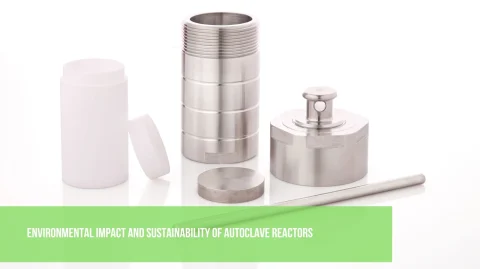
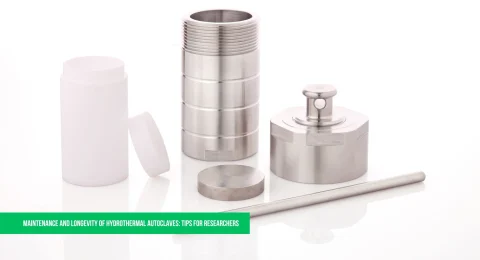
Non-Metallic Options (PTFE, PEEK, Quartz)
PTFE/PFA: Chemically inert (unreactive to most chemicals), excellent for purity-critical work
Limitations: Temperature ceiling (~260°C for PTFE), permeability issues
PEEK: Higher temperature tolerance, good mechanical strength
Quartz: Ultimate purity for semiconductor/materials work, but brittle
Perfect for: Analytical chemistry, battery research, and catalyst studies.
Real-World Scenarios: From Theory to Practice
Scenario A: Hydrothermal Battery Material Synthesis
- Chemistry: LiOH, MnSO₄, 220°C, 24 hours
- Challenge: Strongly alkaline at high temperature
- Solution: Hastelloy C-276 or Titanium (both resist caustic environments)
- Avoid: Stainless steel (will corrode significantly)
Scenario B: Pharmaceutical Intermediate with HCl
- Chemistry: Organic compounds + 10% HCl, 150°C
- Challenge: Acidic chloride environment = pitting corrosion nightmare
- Solution: Hastelloy C-276 (specifically designed for this)
- Avoid: Stainless steel (will fail catastrophically), Titanium (unless dilute)
Scenario C: Ultra-Pure Quantum Dot Synthesis
- Chemistry: Organometallics in organic solvents, 300°C
- Challenge: Any metal contamination ruins optical properties
- Solution: PTFE-lined stainless steel or quartz insert
- Compromise: Pressure limited by liner material
Maintenance & Lifespan: Maximizing Your Investment
Even the perfect material needs proper care:
- Inspect religiously: Check for scratches, pitting, and discoloration.
- Clean appropriately: Different materials need different protocols.
- Document performance: Create a corrosion log for each liner
- Know when to retire: Don’t push liners beyond their safe lifespan.
The Future: Smart Materials & Coatings
Emerging technologies are changing the game:
- Gradient coatings: Different properties at the surface versus the bulk
- Self-healing materials: Minor scratches that “repair” themselves
- Sensor-embedded liners: Real-time corrosion monitoring
- Advanced ceramics: Overcoming brittleness limitations
Conclusion: Your Material Selection Strategy
Selecting an autoclave liner is an optimization problem balancing chemistry, temperature, pressure, purity, and economics. There’s no universal best; only the best material for your application.
Key takeaways:
- Never assume a material’s compatibility; always consult corrosion tables specific to your conditions.
- When in doubt, over-specify toward more resistant materials for safety and reproducibility
- Document everything: your material performance logs become invaluable institutional knowledge.
- Consider the total cost of failed experiments, not just the liner’s price tag.
- Consult with manufacturers: they’ve seen thousands of applications and can provide invaluable guidance.