

Choosing the right high-pressure reactor is essential for the success of your experiments. Three key factors will determine the capabilities and limitations of your system: volume, material, and temperature.
Here’s your essential guide for selecting High Pressure Reactor.
Buy High Pressure Reactor
Volume: From Benchtop Discovery to Pilot-Scale Production
- The reactor volume plays a crucial role in defining the scope of your experiments and their potential for scalability.
- Micro to Bench Scale (50 mL – 500 mL): This scale is Ideal for screening reactions, testing catalysts, and conducting hazardous chemistry, as it reduces reagent usage, enhancing safety. It is primarily suited for the initial discovery phases of discovery.
- Lab Scale (1 L-5 L): This scale is essential for process development and optimization. It provides sufficient product for comprehensive characterization and enables meaningful data collection on kinetics and yield.
- Pilot Scale (10 L – 100 L+): This scale is used to scale up a validated reaction to produce kilogram quantities. It serves as an essential link between laboratory research and full-scale manufacturing.
- The Guideline: Begin with small-scale discovery, then confidently scale up your operations. Ensure your supplier offers a range of sizes to facilitate a smooth transition during scale-up.
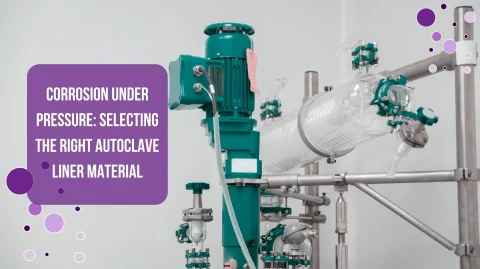
Material of Construction: The Invisible Shield Against Corrosion
- The material used for the reactor is your primary defense against corrosive chemicals, protecting your operation from damage. Choosing wrong can lead to contaminated products, inaccurate data, and catastrophic failure.
- Stainless Steel 316 (SS316): The economic workhorse. Excellent for water, many organic solvents, and basic solutions. It is not suitable for strong acids, chlorides, or other halides, as these can cause pitting corrosion.
- Hastelloy (C-22, C-276): The corrosion-resistant champion. Resistant to chlorides, sulfuric acid, phosphoric acid, and various harsh chemicals, this material is essential for catalysis, petrochemistry, and any reaction involving halogens.
- Titanium & Tantalum: Titanium performs exceptionally well in chloride environments, while Tantalum provides unmatched resistance to acids, making it the top choice for extreme conditions.
- The Guideline: When in doubt, upgrade the alloy. The cost of reactor failure or a ruined experiment far outweighs the initial material cost.
Temperature & Pressure: The Engine of Your Reaction
- Temperature and pressure are essential factors in high-pressure chemistry and are closely interconnected.
- Temperature Range: Most standard reactors function within a temperature range -80°C and 350°C. For temperatures above 350°C, specialized furnaces and alloys are necessary, capable of operating at 500°C or higher.
- Pressure Range: Typical pressure ratings vary from vacuum conditions to 200 bar (approximately 2900 psi). Ultra-high-pressure systems can exceed 1000 bar.
- The Critical Link: It’s important to note that temperature directly influences pressure. If a reaction is heated beyond its intended range, it can easily surpass safe pressure limits. Always know your reaction’s thermodynamics and leave a significant safety margin.
- The Guideline: Your required temperature and pressure should dictate the entire reactor design, including seal type, head fittings, and safety systems.
The Final Check: The Trifecta of Selection
Before you make your specifications, consider the following questions:
- Volume: Do I need to screen, optimize, or produce?
- Material: What is the most corrosive chemical in my process, and which alloy is effective against it?
- Temperature/Pressure: What are my maximum operating conditions, and what safety margin does the reactor provide?
- By systematically evaluating these three key factors, you can move from guesswork to precise engineering. This approach allows you to select a reactor that is more than just a container; it becomes a reliable partner in your research.
Conclusion: Your Reactor is Your Partner in Discovery
Selecting a high-pressure reactor is more than a technical specification exercise—it’s a strategic decision that forms the foundation of your research, process development, or production capabilities. The interplay between volume, material, and temperature/pressure isn’t just about meeting today’s experimental needs; it’s about anticipating tomorrow’s challenges and opportunities.
By carefully considering these three essential factors, you are not only purchasing equipment but also investing in a reliable partner that will enable groundbreaking discoveries, ensure reproducible results, and uphold stringent safety standards. The advanced reactor is an essential extension of your scientific vision, able to withstand the most demanding conditions while providing the precision and performance your work requires.
Remember that the most successful outcomes begin with a strong foundation. Your selection of a high-pressure reactor will significantly impact your research opportunities and how effectively you can turn ideas into reality. Choose wisely, and your reactor will become one of your most valuable scientific tools.