
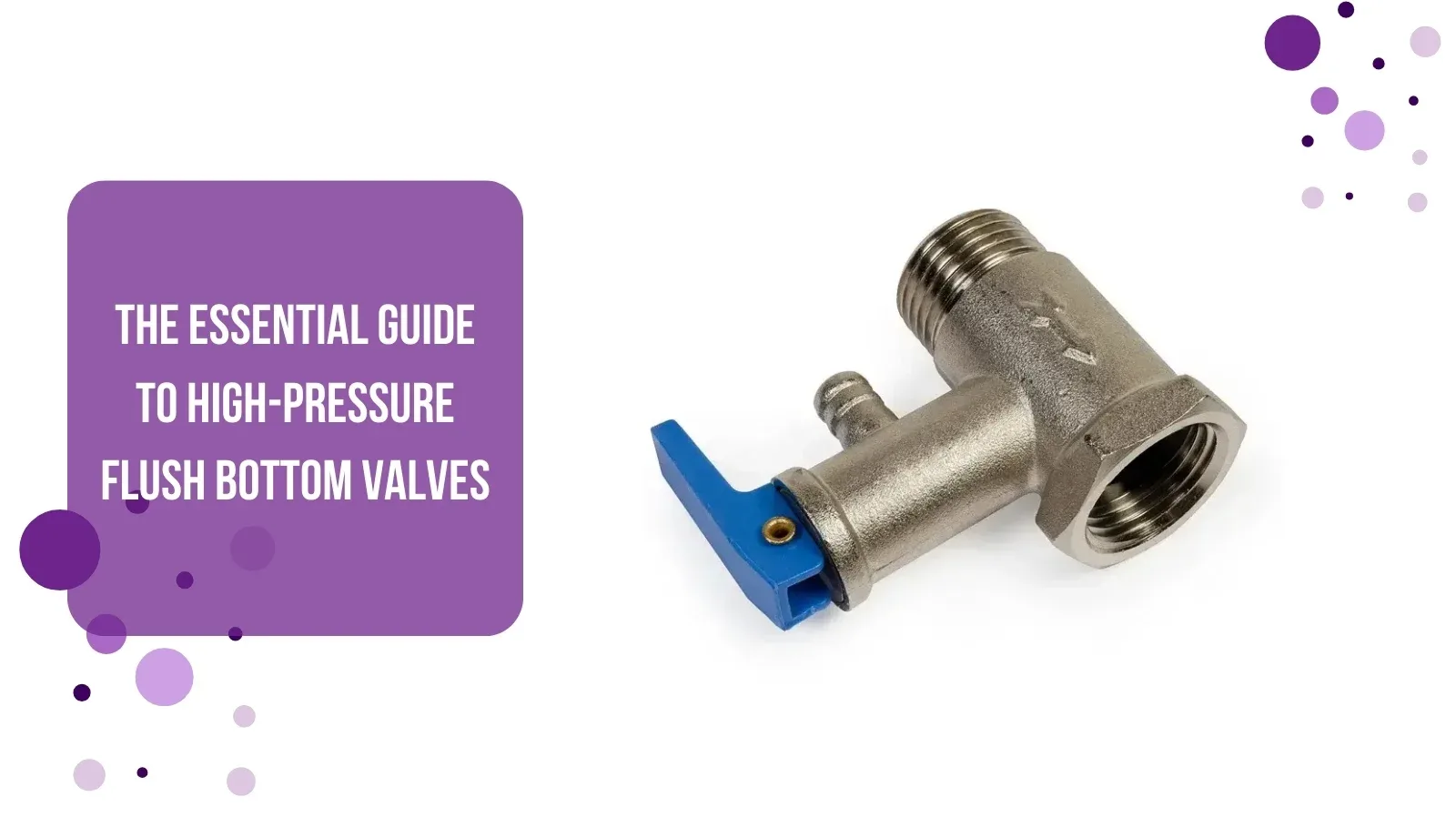
In chemical and pharmaceutical manufacturing, even a tiny amount of leftover residue can ruin an entire batch. That’s where the High-Pressure Flush Bottom Valve, the guardian of the vessel, comes in. Designed to eliminate dead space, these valves are critical for the efficient and pure discharge of materials from reactors and tanks.
What is a High-Pressure Flush Bottom Valve?
A Flush Bottom Valve is a specialized shut-off valve installed at the lowest point of a reactor or storage tank. Unlike standard valves, its seat is designed to sit flush with the vessel’s interior wall. This ensures that no material gets trapped in the nozzle, preventing stagnation, contamination, and clogging.
Key Product Details
- Zero Hold-up Design: Eliminates dead space between the tank and the valve.
- Operating Pressure: Built for high-intensity environments, often rated up to ANSI 300# or higher.
- Materials: Available in SS-316L, Carbon Steel, Hastelloy, and even PFA/PTFE-lined versions for corrosive acids.
- Sealing: Metal-to-metal or PTFE soft seating for leak-proof performance under extreme pressure.
Variations & Technical Capacity
Every industrial process has unique requirements. In a wide range of configurations to confirm a perfect fit for your vessel.
Variation by Design & Mechanism
- Disc Opening into Tank (Upward): The most common type; the disc rises into the vessel to displace any crust or solids forming at the nozzle.
- Disc Opening into Valve (Downward): Used when internal space is limited or when an agitator sweeps close to the bottom of the tank.
- Ram Type (Piston Valve): Features a cylindrical piston that moves into the vessel to punch through thickened slurry or solidified material.
- Jacketed Valves: Equipped with an outer heating/cooling jacket for processes involving resins or bitumen that solidify at room temperature.
- Lined Valves: Internal surfaces are lined with PTFE, PFA, or Glass to handle highly corrosive acids.
Variation by Actuation
- Manual: Operated via a handwheel or gear arrangement for cost-effective control.
- Pneumatic: Driven by air cylinders for rapid, automated switching.
- Electric: Motorized actuators for precise remote control and SCADA integration.
Capacity & Specifications
- Size Range: 15 mm (1/2″) to 200 mm (8″) standard; custom sizes available.
- Pressure Ratings: Engineered for 150# to 600# (ANSI/ASME)
- Temperature Limits: Operates from -20°C to 450°C, depending on material selection.
- Discharge Angles: Outlets at 45° or 60° to ensure high-velocity flow and minimize clogs.
High-Impact Applications
These valves are the backbone of industries where contamination is not an option:
- Pharmaceutical API Production: Facilitates 100% discharge for easy Clean-in-Place (CIP)
- Chemical Reactors: Ideal for polymerization, where solids might settle and harden.
- Food & Beverage: Used for high-viscosity syrups and oils to maintain strict hygiene.
- Slurry Handling: The Ram-type variation is designed specifically to break through solid crusts.
What to Look for in Flush Bottom Valve
Choosing the right valve is a balance between safety and efficiency. Consider these factors:
- Match the Opening Type to Your Agitator: If your stirrer has low clearance, choose the Disc Opening into Valve to avoid internal collisions.
- Prioritize Zero Hold-up: Ensure the seat sits perfectly flush with the tank’s inner diameter to prevent batch-to-batch contamination.
- Material Compatibility (MOC): Don’t settle for standard if your chemistry is aggressive. We offer Hastelloy, Monel, or PTFE-lined options for high-corrosion environments.
- Precision Temperature Monitoring: Look for our integrated RTD (PT100) Sensor in the valve stem to measure the exact temperature at the discharge point.
- Automation: For high-pressure safety, Pneumatic Actuators provide much faster shut-off than manual wheels.
- Jacketing: If your product solidifies as it cools, a Full Jacketed Valve is mandatory to keep the material in a liquid state.
Why Choose Us?
As a specialized Flush Bottom Valve Manufacturer and Supplier, we offer:
- Precision Engineering: Streamlined inlets and outlets to prevent turbulence.
- Custom Metallurgy: We match the material specifically to your chemical process.
- Automated Solutions: Fully integrated systems with limit switches and positioners.
- Reliability: Every valve undergoes rigorous high-pressure testing before shipment.
Conclusion
A High-Pressure Flush Bottom Valve is more than just a drain; it’s a strategic investment in product quality and process safety. By ensuring zero hold-up and a robust seal, it simplifies cleaning and maximizes your yield.